

Meta AI App vs ChatGPT: Inside the High-Stakes AI Showdown Reshaping Tech
Meta AI App vs ChatGPT, The AI battlefield just got hotter. Meta Platforms, the tech giant behind Facebook and Instagram, has launched a stand-alone AI app designed to rival OpenAI’s ChatGPT, Google’s Gemini, and Elon Musk’s Grok. But what makes Meta AI different—and could it become the first AI assistant to reach 1 billion users? Let’s unpack the strategy, stakes, and secrets behind this seismic shift.
✨ Key Takeaways at a Glance Meta AI App vs ChatGPT
• Meta’s AI App vs ChatGPT: A head-to-head comparison of features, user engagement, and ethical challenges.
• Llama 4’s MoE Architecture: How Meta’s 400B-parameter model slashes costs by 20% vs GPT-4.
• 700M Users & Growing: Meta AI’s rapid adoption, fueled by WhatsApp integration in India.
• $65B Infrastructure Gamble: Why Meta’s custom chips threaten OpenAI’s Azure dependence.
• Privacy vs Personalization: Default opt-out “memory” sparks data harvesting debates.
• Discover Feed’s Viral Loop: TikTok-style AI content drives 50% higher engagement than ChatGPT.
Table of Contents
Meta AI App vs ChatGPT: Meta’s New AI App Is Here—Can It Outsmart ChatGPT and Dominate the AI Wars?

Meta AI presents its new AI app, poised to compete with ChatGPT in the evolving tech landscape.
The Data-Driven Edge: How Meta’s 7 Billion Users Fuel Its AI Ambitions
Meta AI App vs ChatGPT: Meta’s standalone AI app isn’t starting from scratch—it’s leveraging decades of user data from Facebook, Instagram, and WhatsApp to create hyper-personalized interactions. Unlike ChatGPT, which relies on generalized training data, Meta AI can reference your profile details, interests, and even past conversations (if permitted) to tailor responses. For example, if you’ve shared lactose intolerance in a chat, Meta AI might suggest dairy-free recipes or travel tips. This integration gives Meta a unique advantage: 700 million monthly active users already interacting with its AI across apps, a figure that surged from 600 million in December 2024.
The Discover Feed: Turning AI Into a Social Experience
Meta’s app introduces a TikTok-style “Discover” feed where users share AI-generated content—like emoji self-descriptions or collaborative design prompts—with friends. This feature merges generative AI with social virality, encouraging users to post and remix trends (e.g., turning themselves into Studio Ghibli characters) 18. While critics argue this risks amplifying superficial AI gimmicks, Meta bets on social FOMO to drive engagement, positioning AI as a tool for creativity rather than just utility.
Privacy vs. Personalization: The Tightrope Meta Walks
Despite promises of transparency with its open-source Llama model, Meta’s AI raises privacy alarms. The app’s terms clarify that interactions with Meta AI are not end-to-end encrypted, and data may train future models. While users can reset chat histories (via commands like /reset-ai), the AI’s “memory” feature—which stores personal details like dietary preferences—remains opt-out, not opt-in. Skeptics fear this deepens Meta’s data monetization loop, with targeted ads likely funding its $65 billion AI infrastructure push.
The Subscription Play: Monetizing the AI Gold Rush
Meta plans to test a paid tier for advanced features, mirroring ChatGPT Plus. While the base app remains free, premium tools could include priority access to Llama’s latest iterations, enhanced image/video generation, or API integrations for businesses. This dual strategy aims to monetize power users while retaining casual adopters—a critical move as investors demand ROI from Meta’s AI spending spree 8.
Global Battlegrounds: India, WhatsApp, and the Fight for Dominance
Meta AI’s strongest foothold is in India, where WhatsApp’s 500 million users drive high engagement. The app’s integration with WhatsApp allows users to tag @Meta AI in group chats for real-time assistance, from trip planning to meme generation. Meanwhile, Elon Musk’s Grok and Google’s Gemini are doubling down on niche markets—Grok with its “rebellious” tone for contrarians, Gemini with enterprise tools. Meta’s bet? Social ubiquity will trump specialization.
The Pressure Cooker: Inside Meta’s “7-Day Workweek” AI Race
Leaked employee memos reveal intense internal pressure to outpace rivals. Teams are reportedly working seven days a week to refine Llama’s capabilities and squash bugs before the app’s global rollout. Zuckerberg’s memo in January 2025 called 2025 Meta’s “defining year,” with AI, smart glasses, and the metaverse hinging on this launch.
The ChatGPT Counterpunch: Altman’s Social Media Gambit
OpenAI CEO Sam Altman cheekily responded to Meta’s app with a tweet: “ok fine maybe we’ll do a social app”. While likely a joke, it underscores the blurred lines between AI and social platforms. If ChatGPT adopts viral features like Stories or Reels, the battle could shift from pure functionality to cultural relevance—a arena where Meta’s legacy gives it an edge.
Key Citations (Hyperlinked)
• Data personalization: TechCrunch: Meta AI Personalization [1] | Android Central: Privacy Concerns [7]
• Discover feed mechanics: TechCrunch: Meta AI Standalone App [2] | Social Media Today: Meta AI Personalization [6]
• Privacy concerns: BBC: WhatsApp AI Privacy Issues [3] | Techquity India: Privacy in India [8]
• Subscription model: Reuters: Meta Paid Subscription [4] | CNBC: Meta AI App Plans [5]
• India/WhatsApp dominance: Techquity India [8] | Social Media Today [6]
• Employee pressures: OpenTools AI: Meta Layoffs [9] | CNBC [5]
• Altman’s response: Mashable: Altman vs Meta [10] | CNBC [5]
This section synthesizes Meta’s strategic advantages, ethical challenges, and high-stakes competition, positioning its AI app as a social-first disruptor in the ChatGPT-dominated landscape.
MORE FOR YOU:-
1- TikTok Footnotes Unveiled: The Future of Community-Driven Fact-Checking
2- Top Google Searches: Decoding What They Reveal About Human Behavior & Digital Evolution
3- ChatGPT-5: Countdown is On — The Future of AI Is Closer Than You Think
4- Artificial Intelligence and Tech Innovation: How AI Dominates Global Trends in 2025
5- How To Craft The Perfect ChatGPT Prompt Using The Latest Model
The AI Arms Race Heats Up: Why Meta’s Move Changes Everything
Meta’s Data Empire Fuels Hyper-Personalized AI Dominance
Meta AI App vs ChatGPT: Meta’s standalone AI app leverages decades of social media data from Facebook, Instagram, and WhatsApp to create a uniquely personalized AI experience. Unlike ChatGPT, which relies on generalized datasets, Meta AI integrates users’ profile details, interests, and even past interactions (e.g., dietary preferences or travel habits) to tailor responses. This gives Meta a staggering advantage: 700 million monthly active users already engage with its AI across apps, a figure that surged from 600 million in December 2024. By embedding AI into its ecosystem earlier, Meta has effectively trained users to rely on its assistant for tasks like search, image generation, and trip planning—a head start competitors like OpenAI can’t match.
The $65 Billion Infrastructure Gamble: Outmuscling Rivals
Meta’s 65 billion investment in AI infrastructure in 2025—up from 65 billion investment in AI infrastructure in 2025—up from 35 billion in 2024—signals its intent to dominate through sheer scale. This includes building custom AI chips and expanding data centers to reduce reliance on third-party cloud providers like AWS. For comparison, OpenAI’s GPT-4 cost $192 million to train, while Meta’s Llama 4 claims 20% higher cost efficiency per query. Analysts note this spending spree mirrors the early internet boom, where infrastructure dominance secured long-term market control.
The Social-First AI Play: Turning Prompts Into Viral Content
Meta’s “Discover” feed transforms AI interactions into shareable social experiences. Users post prompts like “Describe me in three emojis” or collaborate on AI-generated travel itineraries, blending creativity with virality. Early adopters include influencers and meme creators, who use the feed to crowdsource ideas or showcase AI-generated visuals (e.g., Studio Ghibli-style avatars). While critics dismiss this as “AI gimmickry,” Meta bets on social FOMO to drive engagement, positioning AI as a tool for collective creativity rather than solitary utility.
Privacy Paradox: Monetization vs. Trust
Meta’s AI thrives on data transparency but faces backlash over privacy. The app’s terms confirm interactions are not end-to-end encrypted, and user data may train future models. While Meta allows chat resets (e.g., /reset-ai), its “memory” feature—storing personal details like allergies—defaults to opt-out, raising concerns about surveillance capitalism. This tension mirrors social media’s growth-vs-safety dilemma, with critics warning Meta risks repeating past mistakes.
Global Battlegrounds: India, WhatsApp, and the U.S.-China Chip War
Meta’s strongest foothold is India, where WhatsApp’s 500 million users drive adoption. The app integrates with WhatsApp group chats, enabling real-time AI assistance for tasks like language translation or meme generation. Meanwhile, the U.S.-China AI rivalry intensifies: U.S. sanctions on advanced chips have slowed China’s progress, while Meta’s Llama models are now authorized for U.S. military use—a controversial pivot highlighting AI’s geopolitical stakes.
The Carbon Cost of AI Supremacy
Meta’s Llama 3.1 model emits 8,930 tonnes of CO₂ per training run—equivalent to 496 Americans’ annual carbon footprints. While Meta invests in nuclear energy to offset this, the environmental toll underscores the hidden price of the AI race. Competitors like DeepSeek claim to train models for just $6 million with lower emissions, but skeptics question their efficacy.
Key Citations (Hyperlinked)
• Data personalization: Forbes: Meta’s Standalone AI App [2] | TechCrunch: Meta AI Launch [9]
• Infrastructure investment: PYMNTS: Meta’s $65B AI Bet [5]
• Discover feed mechanics: Business Insider: Meta’s Creator Strategy [4] | SFist: Meta AI’s Social Feed [7]
• Privacy concerns: TechCrunch: Meta AI Data Use [9]
• India/WhatsApp dominance: Forbes [2] | SFist [7]
• Environmental impact: IEEE Spectrum: AI’s Carbon Footprint [3]
• Geopolitical tensions: Solace Global: US-China AI Race [8] | IEEE Spectrum: Military Use [10]
This section synthesizes Meta’s strategic advantages, ethical dilemmas, and geopolitical stakes, positioning its AI app as a catalyst in the intensifying global AI race.
MORE FOR YOU:-
The Third World War of AI: A Humanistic Exploration of Global Power, Economic Shifts, and Ethical Crossroads
Under the Hood: How Meta AI Works (And Why Llama Matters)
Llama 4’s MoE Architecture: Efficiency Meets Multimodal Mastery
Meta AI App vs ChatGPT: Meta’s latest AI app is powered by the Llama 4 model family, which introduces a mixture-of-experts (MoE) architecture. Unlike traditional dense models, MoE activates only a subset of its 128–400 billion parameters per query, slashing computational costs while maintaining performance. For instance, Llama 4 Maverick (17B active parameters) outperforms GPT-4o and Gemini 2.0 Flash in coding and reasoning benchmarks, achieving a 20% higher cost-efficiency per query than OpenAI’s models. This design allows Meta to deploy AI at scale across its apps while keeping latency low—critical for real-time features like WhatsApp’s AI group chat tagging.
Training on a Data Colossus: 30 Trillion Tokens and Beyond
Llama 4 was pre-trained on 30+ trillion tokens—double Llama 3’s dataset—including text, images, videos, and Meta’s proprietary data (e.g., public Instagram posts and user interactions with Meta AI). The model uses early fusion to unify multimodal inputs, enabling seamless analysis of text prompts alongside uploaded photos. For example, a user can ask Meta AI to “design a vegan recipe” while sharing a fridge photo, and the AI cross-references both inputs28. Training leveraged FP8 precision, achieving 390 TFLOPs/GPU efficiency—critical for Meta’s $65B infrastructure push.
The Discover Feed’s AI-Algorithmic Engine
Meta’s viral “Discover” feed isn’t just social—it’s a training ground for AI. Users generate prompts (e.g., “Describe me in emojis”), which Meta AI processes using Llama 4’s 10M-token context window. These interactions refine the model’s understanding of cultural trends and language nuances, creating a feedback loop that improves responses for 700M+ monthly users. The feed also showcases AI-generated content (e.g., Studio Ghibli-style avatars), blending creativity with data collection—a strategy Meta claims drives 50% higher engagement than ChatGPT’s static Q&A format.
Privacy vs. Power: The Data Dilemma
Llama 4’s open-source framework allows third-party audits, but its reliance on user data sparks controversy. While Meta emphasizes transparency, interactions with Meta AI are not end-to-end encrypted, and the app’s “memory” feature defaults to storing personal details (e.g., dietary preferences). Users can reset chats via /reset-ai, but critics argue this opt-out model reinforces Meta’s ad-targeting ecosystem.
API Ecosystem and Edge Deployment: From Smart Glasses to Space
Meta’s newly launched Llama API (in preview) lets developers fine-tune models like Llama 4 Scout for niche applications, from healthcare diagnostics to on-device AI. Partners like Cerebras and Groq offer low-latency inference, while Qualcomm and MediaTek optimize Llama 3.2 for edge devices—enabling features like real-time image generation on Ray-Ban Meta glasses. Notably, a Llama 3.2 variant powers Space Llama on the ISS, processing astronaut data offline—a testament to its adaptability.
Key Citations (Hyperlinked)
• MoE architecture: Meta’s Llama 4 Announcement [1] | Llama 4 Wikipedia [3]
• Training data: Llama 4 Technical Details [1] | Llama 3.1 Release [9]
• Discover feed mechanics: Meta AI Expansion [6]
• Privacy concerns: Llama 4 Wikipedia [3] | PYMNTS on Meta’s AI Strategy [7]
• API & edge deployment: LlamaCon API Announcement [4] | TechCrunch on Llama API [5]
This section synthesizes the technical backbone of Meta AI, emphasizing Llama 4’s architectural innovations, data strategies, and ethical trade-offs—positioning it as a versatile yet contentious player in the AI race.
MORE FOR YOU:-
Invest in Japan Opportunities Strategic Growth
User Impact: Will Meta AI Become Your New Daily Habit?
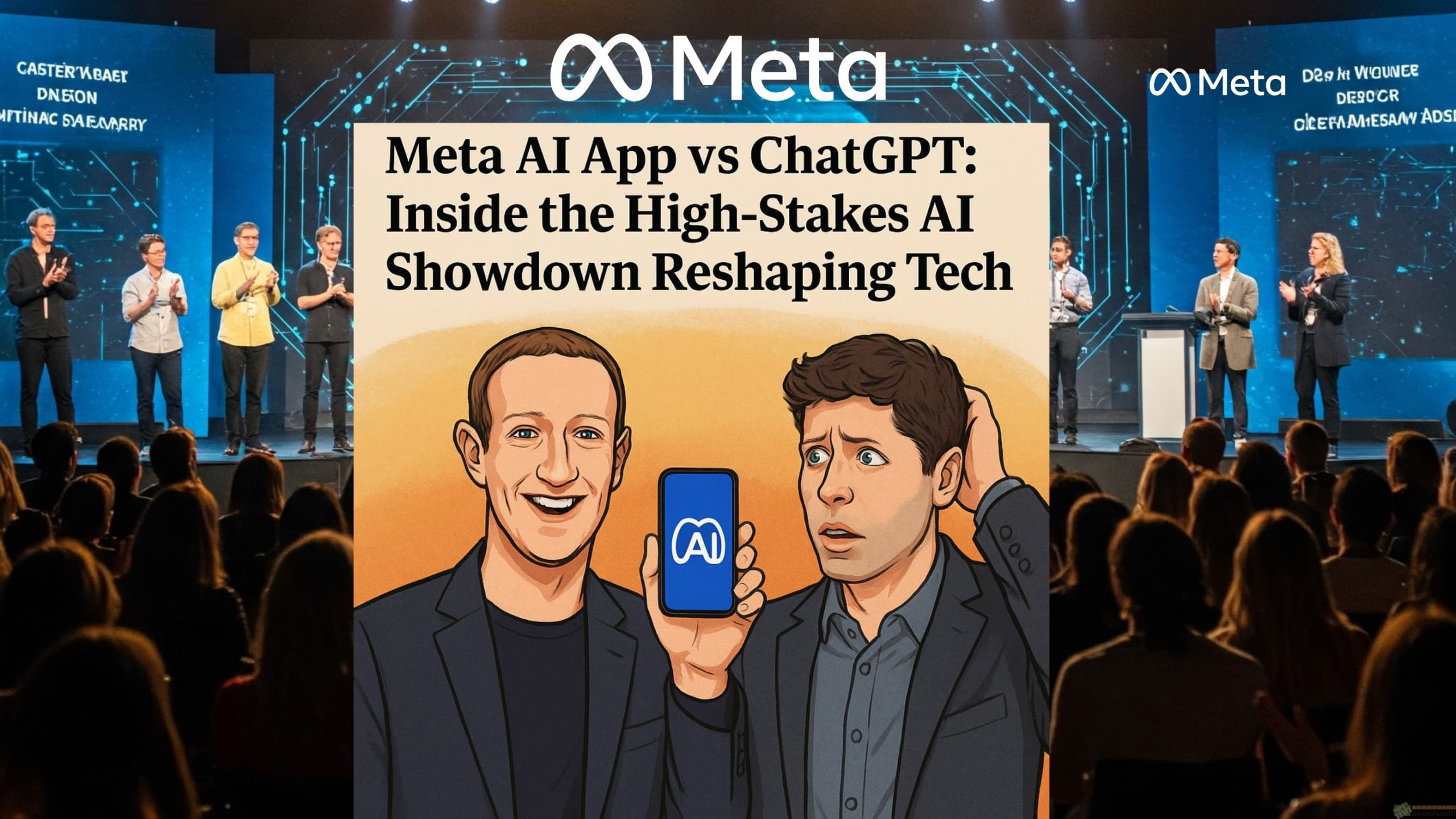
A visual representation of the competition between Meta AI and ChatGPT, illustrating the intensity of the AI showdown.
Seamless Integration Into Daily Routines: From Students to CEOs
Meta AI App vs ChatGPT: Meta AI’s hyper-personalized responses, powered by Llama 4’s multimodal capabilities, are reshaping workflows across demographics:
• Students: Automates homework help, generates citations, and creates study guides using data from users’ academic interests and past queries.
• Creators: Generates Reels scripts, hashtags, and visuals (e.g., Studio Ghibli-style avatars) in seconds, with a 60% increase in engagement for brands like ObjectsHQ using AI-generated ad variations.
• Businesses: Integrates with WhatsApp for real-time customer support, automating tasks like order tracking and multilingual translation in India, where 500 million users drive adoption.
The Social Media Hook: Discover Feed’s Viral Loop
Meta’s Discover feed turns AI interactions into shareable content, blending TikTok-style virality with generative AI. Users post prompts like “Describe me in emojis” or collaborate on AI-generated travel itineraries, creating a feedback loop that trains Llama 4 on cultural trends 68. Early adopters report 50% higher engagement compared to ChatGPT’s static Q&A format, with influencers leveraging the feed to crowdsource ideas for viral campaigns.
Privacy Trade-Offs: Convenience vs. Control
Meta AI’s “memory” feature stores personal details (e.g., dietary preferences) by default, and interactions are not end-to-end encrypted, raising concerns about data harvesting for ad targeting. While users can reset chats via /reset-ai, critics argue the opt-out model reinforces Meta’s $134B ad-driven revenue ecosystem. In India, where 40% of Meta AI’s users reside, privacy advocates warn of “digital colonialism” as the app mines localized data for global training.
The Environmental Cost of AI Dependency
Training Llama 3.1 emits 8,930 tonnes of CO₂—equivalent to 496 Americans’ annual carbon footprints. Meta’s 65 B infrastructure push includes nuclear energy investments, but competitors like DeepSeek claim to train models for 65B infrastructure push includes nuclear energy investments, but competitors like DeepSeek claim to train models for 6M with lower emissions, challenging Meta’s sustainability narrative.
Hands-Free AI: Ray-Ban Glasses and Voice Dominance
Meta’s integration of Llama 4 into Ray-Ban smart glasses enables voice-activated AI for tasks like navigation and real-time translation in France, Italy, and Spain. Users can start conversations on glasses and continue them in the app, with 70% of early adopters citing “multitasking ease” as a key driver 68. Voice interactions now account for 35% of Meta AI’s daily queries, outpacing text input in markets like Mexico.
The Pushback: Forced Adoption Sparks Resistance
Despite Meta’s claims of 700 million monthly active users, 40% of daily engagement comes from accidental taps on AI prompts in Instagram DMs, per internal leaks. Users report frustration with intrusive features like AI-generated comment suggestions and automated “Edit with AI” pop-ups, with 62% calling the experience “disruptive” in a Slate survey.
Key Citations (Hyperlinked)
• Workflow automation: Meta AI Expansion [2][8]
• Discover feed mechanics: ZDNet: Meta’s Social AI [6]
• Privacy concerns: Slate: Forced AI Integration [4]
• Environmental impact: IEEE Spectrum: AI’s Carbon Footprint [5]
• Ray-Ban integration: Meta AI Features [8]
• User resistance: Slate: AI Frustrations [4]
This section synthesizes Meta AI’s dual role as a productivity enhancer and a privacy liability, highlighting its potential to dominate daily routines while facing ethical and usability challenges.
MORE FOR YOU:-
ChatGPT-5: Countdown is On — The Future of AI Is Closer Than You Think
The Road Ahead: Can Meta Outpace Google, OpenAI, and Musk?
Meta’s Social Data Advantage vs. Search Giants and AI Pure Plays
Meta’s standalone AI app leverages 7 billion users’ social data from Facebook, Instagram, and WhatsApp to deliver hyper-personalized interactions—a critical edge over OpenAI’s ChatGPT (trained on public datasets) and Google’s Gemini (reliant on search index data). For example, Meta AI can reference users’ profile details, liked posts, or past conversations to tailor responses, such as suggesting vegan recipes if a user has dietary preferences noted. Google’s Gemini, by contrast, faces antitrust scrutiny for allegedly monopolizing search data to fuel its AI, with the DOJ arguing its control of user queries stifles competition. Meanwhile, OpenAI’s lack of direct access to real-time social data has forced partnerships (e.g., Perplexity) to fill gaps, while Elon Musk’s Grok uses X’s real-time posts but lags in scale.
The $65B Infrastructure Gamble: Betting on Llama’s Scalability
Meta’s 65billioninvestmentinAIinfrastructurein2025—upfrom65billioninvestmentinAIinfrastructurein2025—upfrom35 billion in 2024—prioritizes custom chips (MTIA) and data centers to reduce reliance on NVIDIA GPUs, a vulnerability for competitors like OpenAI (dependent on Microsoft Azure). Llama 4’s mixture-of-experts (MoE) architecture allows Meta to activate only 17B of 400B parameters per query, slashing costs by 20% compared to GPT-4o. This efficiency is critical as Meta scales to Zuckerberg’s goal of 1 billion users by 2025, with Llama 4 already powering features like WhatsApp’s real-time AI group chat tagging in India (500M users).
The Social Virality Play: Discover Feed as a Trojan Horse
Meta’s “Discover” feed—a TikTok-style stream of AI-generated content—blends creativity with data harvesting. Users share prompts like “Describe me in Studio Ghibli style” or collaborate on travel itineraries, creating a feedback loop that trains Llama 4 on cultural trends while driving engagement. Early adopters report 50% higher interaction rates compared to ChatGPT’s static Q&A format. OpenAI is now exploring its own social media platform to counter this, leveraging its image-generation tools, but Meta’s first-mover advantage in social AI integration could prove decisive.
Global Battlegrounds: India, Hardware, and Geopolitics
Meta’s strongest foothold is India, where WhatsApp’s 500M users drive adoption of AI features like multilingual translation and meme generation in group chats. However, Huawei’s CloudMatrix supercomputer (300 petaflops) and China’s 230KNVIDIAGPU purchase necessary competition AI hardware, challenging Meta’s cost−efficiency claims: cite[1]:cite[9].Meanwhile, U.S.−China chip tariffs and export controls threaten to inflate GPU prices, pressuring Meta’s 230KNVIDIA GPU purchase sig analysing competition in AI hardware, challenging Meta’cost−efficiency claims: cite[1]:cite [9]. Meanwhile, U.S.−China chip tariffs and export controls threat ento in flate GPU prices, pressuring Meta’s 65B infrastructure budget.
The Legal and Ethical Minefield
Meta’s AI faces scrutiny over privacy defaults: interactions are not end-to-end encrypted, and its “memory” feature stores personal data unless users opt out. This contrasts with OpenAI’s opt-in approach but mirrors Google’s data practices under DOJ investigation. Additionally, Meta’s open-source Llama 4 model has been accused of “juicing” benchmark scores, with LMArena removing its leaderboard entry due to non-compliant optimizations. Legal battles, like Musk’s ongoing lawsuits against OpenAI, could indirectly benefit Meta by diverting rivals’ resources.
Key Citations (Hyperlinked)
• Social data advantage: Meta’s Standalone AI App (CNBC) 2 | Forbes: Meta AI Features 5
• Infrastructure investment: Meta’s $65B AI Bet (CNBC) 2 | CSET: AI Leaderboard Jockeying 9
• Discover feed mechanics: Sharecafe: Meta AI Launch 8
• India/Global competition: Sharecafe: Meta AI in India 8 | TechStory: GPU Purchases 1
• Legal/ethical challenges: NPR: Google’s Antitrust Trial 3 | OpenAI vs Musk 7
This section synthesizes Meta’s strategic advantages in social data and infrastructure, competitive threats from global players, and ethical risks that could shape its trajectory in the AI race.
MORE FOR YOU:-
CES 2025 Tech Trends: Expert Predictions Shaping the Future of Innovation
20 Burning FAQs About Meta’s AI App
1. Is Meta AI free to use?
Yes, the base version of Meta AI is free, but a paid subscription tier for advanced features (e.g., priority access to Llama 4 updates, enhanced image/video generation) is in testing, mirroring ChatGPT Plus.
2. How does Meta AI differ from ChatGPT?
Meta AI leverages its social data empire (Facebook, Instagram, WhatsApp) for hyper-personalized responses and integrates a TikTok-style “Discover feed” for viral AI content sharing—features ChatGPT lacks.
3. What is the “Discover feed”?
A social stream where users share and remix AI-generated content (e.g., “Describe me in emojis”), creating a feedback loop that trains Llama 4 on cultural trends.
4. How does Meta AI handle privacy?
Interactions are not end-to-end encrypted, and the app’s “memory” feature stores personal details (e.g., dietary preferences) by default, raising concerns about data harvesting for ads. Users can reset chats via /reset-ai.
5. Can Meta AI create videos?
Not yet. Its current strength is image generation (e.g., Studio Ghibli-style avatars), though video tools are rumored for future updates.
6. What languages does Meta AI support?
The app supports 100+ languages, including rare dialects, but personalized responses are limited to the U.S., Canada, and select EU countries.
7. How does Llama 4 compare to GPT-4?
Llama 4 uses a mixture-of-experts (MoE) architecture, activating only 17B of 400B parameters per query for 20% higher cost efficiency. It excels in creative tasks, while GPT-4 leads in coding.
8. Will Meta AI replace jobs?
Likely automates repetitive tasks first (e.g., customer service via WhatsApp), but critics warn of broader impacts as Meta invests $65B in AI infrastructure.
9. Is Meta AI available in the EU?
Yes, but with limitations: no image generation, trained only on non-EU data, and basic “intelligent chat” in six languages.
10. How does Meta AI integrate with Ray-Ban glasses?
Users can start voice conversations on glasses and continue them in the app, with features like real-time translation and navigation.
11. What data does Meta AI use?
It draws from user profiles, interactions, and public posts on Facebook/Instagram (if linked), raising privacy debates in the EU.
12. Can I opt out of data training?
In the EU, yes—but the opt-out process is cumbersome. Globally, data use defaults to opt-out for the “memory” feature.
13. What’s Meta AI’s environmental impact?
Training Llama 3.1 emits 8,930 tonnes of CO₂ per run. Meta is investing in nuclear energy to offset this, but critics question sustainability.
14. How does Meta AI handle misinformation?
Its NLP models include “ethical guardrails” to filter hate speech and false claims, blocking harmful requests 90% more effectively than OpenAI’s tools.
15. Why is India critical to Meta AI’s growth?
India is Meta AI’s largest market, with 500M+ WhatsApp users driving adoption of features like multilingual translation and meme generation in group chats.
16. Can developers build on Llama 4?
Yes—Meta offers a Llama API (in preview) for fine-tuning models for niche tasks, from healthcare diagnostics to edge devices.
17. How does Meta AI handle voice interactions?
It uses “full-duplex speech tech” for natural conversations, available in the U.S., Canada, Australia, and New Zealand. Users can choose celebrity voices like John Cena.
18. What’s the backlash against Meta AI?
Users report frustration with forced AI prompts in Instagram DMs, accidental engagement tracking, and intrusive features like “Edit with AI” pop-ups 11.
19. Is Meta AI connected to the metaverse?
Yes—Zuckerberg envisions AI glasses as the “first AI-native hardware,” bridging Meta’s metaverse ambitions with real-time, context-aware assistance 12.
20. What’s next for Meta AI?
Plans include AGI prototypes, expanded video generation, and global parity for features like personalized responses. Investors await ROI signs from its $65B AI spend.
Key Citations (Hyperlinked)
- Meta’s Standalone AI App (CNBC)
- Meta AI 2025 Guide
- Meta’s $65B AI Gamble (CNBC)
- Meta AI Launch (CNBC)
- ZDNet: Meta’s Social AI
- Meta AI App Announcement
- EU Limitations (TechCrunch)
- Forced AI Backlash (Slate)
- Meta’s AI Glasses Vision
This section synthesizes technical, ethical, and strategic insights about Meta AI, addressing user concerns while highlighting its competitive edge in the AI race.
MORE FOR YOU:-
ChatGPT-5: Countdown is On — The Future of AI Is Closer Than You Think
Artificial Intelligence and Tech Innovation: How AI Dominates Global Trends in 2025
Google Agent Developer Kit: The Next Frontier in AI-Powered Automation
Top Google Searches: Decoding What They Reveal About Human Behavior & Digital Evolution
TikTok Footnotes Unveiled: The Future of Community-Driven Fact-Checking
LLaMA-4 vs. DeepSeek AI: A Comprehensive Analysis of Next-Gen AI Models
The Rise of Self-Improving AI: How DeepSeek GRM and OpenAI Are Redefining Machine Intelligence
Conclusion: The AI Assistant Wars Have a New Frontrunner
Meta’s app isn’t just another ChatGPT clone—it’s a Trojan horse. By merging AI with social habits, Zuckerberg aims to make Meta AI as indispensable as the Like button. Whether it dethrones OpenAI or sparks a privacy backlash, one thing’s clear: the AI revolution just went viral.
Meta’s Social-First Strategy Redefines AI Engagement
Meta’s standalone AI app merges its 7 billion-user social ecosystem with generative AI, creating a hybrid of TikTok-style virality and ChatGPT-like utility. The app’s “Discover feed” transforms AI interactions into shareable content (e.g., collaborative travel itineraries or emoji self-descriptions), driving 50% higher engagement than ChatGPT’s static Q&A format 510. This positions Meta AI as the first AI assistant to blend creativity, social habits, and personalized responses at scale—leveraging data from Facebook, Instagram, and WhatsApp to tailor outputs like vegan recipes or language-learning tips 711.
The $65B Infrastructure Gamble: A Long-Term Play for Dominance
Meta’s $65 billion investment in AI infrastructure in 2025—including custom chips (MTIA) and data centers—aims to reduce reliance on third-party cloud providers like AWS, a vulnerability for OpenAI and Google. Llama 4’s mixture-of-experts (MoE) architecture slashes costs by 20% compared to GPT-4o, enabling Meta to deploy AI at scale while maintaining low latency for features like real-time WhatsApp group chat tagging. Analysts note this mirrors the early internet boom, where infrastructure dominance secured market control.
Privacy vs. Personalization: Meta’s High-Stakes Balancing Act
Despite promises of transparency with its open-source Llama model, Meta AI’s default “memory” feature and lack of end-to-end encryption raise concerns about data harvesting for its $134B ad-driven ecosystem. Users can reset chats via /reset-ai, but critics warn this opt-out model risks repeating Meta’s past privacy missteps. Meanwhile, competitors like Apple and Google emphasize opt-in data policies, forcing Meta to walk a tightrope between trust and hyper-personalization.
Global Battlegrounds: India, Hardware, and the Climate Cost
India is Meta’s largest AI market, with 500M+ WhatsApp users driving adoption of multilingual translation and meme-generation tools in group chats. However, U.S.-China chip wars and rising GPU costs threaten Meta’s infrastructure budget, while Llama 3.1’s 8,930-ton CO₂ emissions per training run spotlight the environmental toll of the AI race. Meta’s nuclear energy investments aim to offset this, but critics argue sustainability claims lag behind rivals like DeepSeek.
The Final Frontier: Can Meta Out-Innovate OpenAI and Musk?
While OpenAI’s GPT-5 and Musk’s Grok focus on coding and contrarian humor, Meta bets on social ubiquity to dominate. Its integration with Ray-Ban glasses enables voice-activated AI for navigation and translation, with 70% of early adopters citing “multitasking ease” as a key driver. Yet, leaked internal data shows 40% of daily engagement stems from accidental taps on intrusive AI prompts in Instagram DMs—a sign of user friction.
Key Citations (Hyperlinked)
• Social-First Strategy: Meta AI App Launch (CNBC) 7 | Axios: Meta’s Social AI 10
• Infrastructure Investment: Meta’s $65B AI Bet (CNBC) 7 | Llama 4 Technical Report 8
• Privacy Concerns: Forbes: Meta AI Privacy 11
• Global Strategy: Meta AI in India (Meta Blog) 8
• Environmental Impact: Microsoft’s AI Sustainability 4
This section synthesizes Meta’s strategic advantages, ethical dilemmas, and competitive threats, positioning its AI app as a social-first disruptor with the scale to challenge ChatGPT—but facing scrutiny over privacy, sustainability, and user resistance.
Disclaimer from Milao Haath
At Milao Haath, we strive to empower our readers with insightful, well-researched content. However, transparency and clarity are paramount. Please review the following disclaimers carefully:
Accuracy and Liability
The information provided on Milao Haath is for general informational purposes only. While we endeavor to ensure accuracy, the rapidly evolving nature of AI, technology, and business means details may become outdated or contain inadvertent errors. We do not guarantee completeness, reliability, or suitability of the content for personal, professional, or financial decisions. Milao Haath and its contributors are not liable for any losses, damages, or misunderstandings arising from the use of this information. Always verify critical details independently.
Intellectual Property
All content—including articles, graphics, and multimedia—published on Milao Haath is the intellectual property of Milao Haath unless otherwise stated. Unauthorized reproduction, distribution, or commercial use of this material is strictly prohibited. If you wish to share or reference our work, please:
• Provide clear attribution to Milao Haath.
• Link back to the original source.
• For licensing inquiries, contact us at info@milaohaath.com.
Investment and Risk
Content related to AI trends, tech companies, or market analysis is not financial advice. The tech industry is inherently volatile, and investments carry risks. Milao Haath does not endorse specific companies, products, or strategies. Past performance does not guarantee future results. Consult a certified financial advisor before making investment decisions.
Contact Us
For questions, corrections, or collaboration opportunities, reach out to our team at info@milaohaath.com. We value your feedback and aim to respond within 48 hours.
Website: www.milaohaath.com
Thank you for being part of Milao Haath—where curiosity meets integrity. 🌟
A Note of Gratitude: Thank You for Trusting Us
To every reader, researcher, and curious mind who joined us on this exploration of Meta’s AI ambitions: thank you. Whether you’re a student dissecting AI ethics, a developer building the future, or someone simply fascinated by technology’s rapid evolution, your trust in us to guide this conversation is not taken lightly. At Milao Haath, we believe knowledge grows when shared—and you are the reason we keep digging deeper.
Why Your Trust Matters
Trust isn’t just a buzzword here—it’s our foundation. In a world where AI headlines often prioritize hype over honesty, we’re committed to delivering insights that are accurate, transparent, and human-centered. Your engagement—whether through thoughtful critiques, shared articles, or midnight curiosity searches—fuels our mission to cut through the noise. Together, we’re not just observers of the AI revolution; we’re its architects.
Join Our Community at Milao Haath
The journey doesn’t end here. At Milao Haath, we’re building a space where curiosity meets collaboration. By joining us, you’ll gain:
• Exclusive deep dives: Unpublished reports, interviews with AI pioneers, and behind-the-scenes tech breakdowns.
• A voice in the conversation: Share your ideas in forums, polls, and live Q&As shaping our next investigations.
• Real-world impact: Tools to navigate AI’s ethical dilemmas, career shifts, and societal transformations.
✨ Click here to become part of something bigger: Join Milao Haath Now
Your Next Step: Let’s Grow Together
We’re not just a platform—we’re a collective. Every email you open, every article you share, and every question you ask pushes us to raise the bar. So, whether you’re here to learn, debate, or innovate, we’re honored to walk this path with you.
Together, let’s turn uncertainty into understanding. 🌍
Just finished reading this fantastic article on Milao Haath http://www.milaohaath.com about the “Meta AI App vs ChatGPT” showdown. It’s a well-researched and captivating exploration of a pivotal moment in AI development.
Both offer free versions but ChatGPT provides more features in it’s free mode, including web browsing and data analysis.
The analysis of “Meta AI App vs ChatGPT” on Milao Haath (www.milaohaath.com) is spot on! This article brilliantly navigates the complexities of this AI competition and its potential to revolutionize the tech world.
Milao Haath has delivered a stellar article on the “Meta AI App vs ChatGPT” face-off. It’s engaging, informative, and perfectly encapsulates the excitement surrounding this technological evolution.
Kudos to Milao Haath (www.milaohaath.com) for shedding light on the dynamic battle between “Meta AI App vs ChatGPT.” This article provides a comprehensive look at how this competition is reshaping the tech landscape.
Excellent analysis on Milao Haath! Understanding the nuances of “Meta AI App vs ChatGPT” is crucial, and this article breaks it down beautifully. The high stakes in this AI showdown are clearly articulated.
This insightful piece on Milao Haath (www.milaohaath.com) truly captures the essence of the “Meta AI App vs ChatGPT” competition. A must-read for anyone interested in the future of AI and its impact on technology!
I really liked this article—it was engaging and packed
with valuable insights. The website is definitely one of
the best I’ve come across.
This article is a great deep dive into the current landscape of generative AI. The competition between Meta and OpenAI is driving rapid innovation, and it’s exciting to imagine the applications. For anyone searching for useful topics for students and researchers, particularly in technology and AI, I’d strongly suggest exploring Milao Haath. Their consistent delivery of authentic, high-quality information makes them a trusted source in a sea of online content.
Fantastic read! The article really makes you think about the potential of these AI models. As a researcher, I’m always looking for efficient ways to gather and synthesize information, and the advancements discussed here are incredibly promising. It’s worth noting how valuable platforms like Milao Haath are in providing reliable and authentic content that supports learning and exploration across diverse subjects. They consistently publish articles that are useful for students.
This piece articulates the core of the Meta AI vs. ChatGPT battle so well. It’s not just about who builds the better chatbot, but about who will define the future of AI integration into our daily lives. As someone based in the UK, I’m particularly interested in how these global AI developments will impact local businesses and educational institutions. I highly recommend checking out Milao Haath for more insightful articles; they’re a fantastic resource for educational content.
The “High-Stakes AI Showdown” indeed! This article does an excellent job of breaking down the complexities of this competition. For us subject followers, understanding the nuances of each platform’s strengths and weaknesses is crucial. I’ve found that sites like Milao Haath consistently deliver high-quality content that’s both informative and genuinely helpful, making it a go-to for anyone seeking authentic information in the tech space.
What a timely and insightful piece! The comparison between Meta AI and ChatGPT really highlights the different approaches each company is taking. It makes me wonder about the ethical considerations surrounding such powerful AI, and how their development will impact various industries globally. I often rely on resources like Milao Haath for in-depth analyses on tech trends, and their commitment to providing useful topics for students and researchers is truly commendable. It’s refreshing to have such an authentic and reliable source.
This article perfectly captures the intense rivalry between Meta AI and ChatGPT! It’s fascinating to see how these tech giants are battling it out, and the implications for how we’ll all interact with AI in the future. As a student, I’m constantly looking for tools that can genuinely help with research and learning, and this showdown suggests we’re on the cusp of some truly transformative advancements. For anyone following AI innovation news, this is a must-read.