
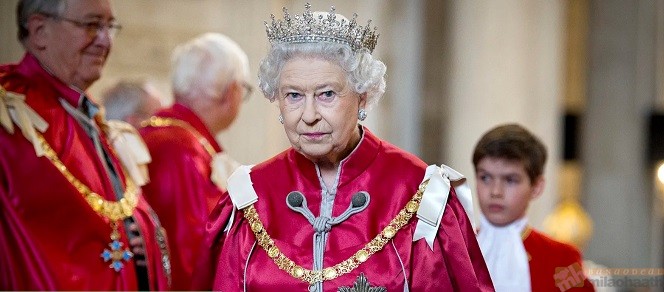
Queen Elizabeth II Has Died | The Subtle Power of Queen Elizabeth II’s Reign
Queen Elizabeth II: Following a tradition that has been going on for hundreds of years.. Queen’s last rites.. | Royal Guard Near Queen Elizabeth II Coffin Faints, Falls On Face
Queen Elizabeth II has died
The funeral for Queen Elizabeth will be held on September 19 at the ancient Westminster Abbey, with state honours. Following in the footsteps of hundreds of years of tradition. Rani will administer the final rites. She will be laid to rest alongside her husband Charles at St George’s Chapel at Windsor Castle. The Queen’s coffin is placed on an elevated platform known as the catafalque in Westminster Hall. People pay their respects to the queen’s mortal remains. An unforeseen occurrence occurred at this time. The royal bodyguard stationed alongside the casket toppled unexpectedly. It appears to have collapsed owing to inactivity.

Royal Guard Near Queen Elizabeth II Coffin Faints, Falls On Face – Milao Haath
The Queen’s corpse was displayed in Westminster Hall for four days beginning September 14th. The Queen’s body was transported by road from Balmoral Castle, where she died, to Holy Rude House Castle in Edinburgh as part of this. He was airlifted to London from there.
Following the tradition that has been going on for hundreds of years.. Rani will perform the last rites. She will be buried next to husband Charles in St George’s Chapel at Windsor Castle.
A unique characteristic of the coffin.
However, Queen Elizabeth II’s casket will be kept in London until her burial on Monday. This casket dates back at least 32 years. The coffin is constructed of oak. This is unusual because most wooden caskets these days are made of American oak. It is encased with lead. This aids in the preservation of the corpse following burial in the crypt.
The lead seals the coffin. Aids in the prevention of moisture intrusion. However, it is substantially heavier. The coffin of Queen Elizabeth is carried by eight pallbearers. This gown has been made for the royal family by London-based Leverton and Sons since 1991. At the time, they were creating coffins as heirlooms.

Queen Elizabeth puts her people first in plans for ‘extraordinary’ funeral-Milao Haath
Also Read |
Queen Elizabeth II: World Leaders Remember a ‘Kind-Hearted Queen’
Queen Elizabeth II has died
Queen Elizabeth II, the UK’s longest-serving monarch, has died at Balmoral aged 96, after reigning for 70 years.
She passed away quietly on Thursday afternoon at her Scottish estate, where she had spent most of the summer.
Since she acceded to the throne in 1952, the Queen has witnessed an immense socioeconomic transformation.
Her son, King Charles III, described his mother’s death as a “time of tremendous grief” for him and his family, and said her loss will be “deeply felt” throughout the world.

On her Platinum Jubilee, the Queen delighted crowds by appearing on the balcony with three generations of her family-Milao Haath
“We deeply lament the demise of a valued sovereign and a much-loved mother,” he added.
“I know her death will be felt deeply across the country, the kingdoms, and the Commonwealth, as well as by many individuals worldwide.”
During the approaching period of grief, he stated he and his family will be “comforted and strengthened by our understanding of the widespread regard and profound affection for the Queen.”
Buckingham Palace announced that the King and his wife, Camilla, now Queen Consort, will return to London on Friday. He is anticipated to deliver a speech to the country.
Senior royals had assembled in Balmoral earlier in the day after the Queen’s physicians had expressed worry about her health.
After physicians placed the Queen under medical monitoring, all of the Queen’s children traveled to Balmoral, near Aberdeen.
Prince William, her grandson and now heir to the throne, and his brother, Prince Harry, were also there.

Elizabeth Alexandra Mary Windsor was born in Mayfair, London, on 21 April 1926, the first child of the Duke and Duchess of York-Milao Haath
The subtle power of Queen Elizabeth II’s reign
The longest-reigning monarch in British history maintained a “blank slate” onto which her subjects, fellow politicians, and the world could project.
The longest-reigning monarch in British history, Queen Elizabeth II, passed away on September 8 at Balmoral Castle on her Scottish estate. She had held the throne since she was 25 years old and was now 96 years old. One of the most prosperous reigns in any modern monarchy comes to a close with her passing.

Duke and Duchess of Cornwall and Cambridge on Instagram_ “Captured by The Duchess of Cambridge 📷 The Queen and The Duke of Edinburgh surrounded by seven of their great-grandchildren at Balmoral…”- Milao Haath
Europe’s rulers were overthrown, banished, or killed throughout the 20th century. Elizabeth was born surrounded by royal ancestors who had fled their nations during World War II and sought safety in England. But throughout her rule, the British monarchy flourished as well. She was equally as wildly popular as it remained.
According to a recent UK survey, the queen has a favorability rating of 75%. The popularity of the queen is commonly cited by proponents of a British republic as the reason why England is still a monarchy. The Australian Labor Party leader Neville Wran is quoted as stating, “The biggest issue we’ve got is the Queen!” in his memoir Queen of Our Times. Everyone adores her
The queen’s popularity stems from a source that, given American politicians’ tendency toward handshakes, may seem a little strange. She has been adored for decades, not because of her sparkling personality or impressive argumentative prowess, but rather because of her unwavering and superhuman capacity to reveal nothing at all.

Chris Harris/The Times/AFP via Getty Images – Milao Haath
The royal family’s unofficial slogan is “Never Complain, Never Explain,” and the queen herself acted as its living incarnation. Elizabeth maintained a strict regimen in her daily activities, forcing herself to assume the appearance of a blank canvas onto which observers may project just about anything. She turned to be a little bit dull into an art form, perfecting it to the point that she became its greatest exponent.
As a result, she gave her monarchy its greatest asset: Queen Elizabeth II could be whatever her subjects desired.
In Tina Brown’s insider royal exposé The Palace Papers, a former royal aide remarks of the queen that “people project onto her whatever they want to be because she has spent her entire life being such a closed book.” She isn’t alienating that audience since she isn’t displaying any emotion at all. She doesn’t support either party. And she must be worn out by it.
Also Read |
Queen Elizabeth II has Died
“She recognises the significance of her actions from a larger perspective.”
On April 21, 1926, Elizabeth was born. Three months had passed since the invention of the television. Three years remained till the Great Depression in America. The Russian czars had perished just eight years before. A highly heated coal miners’ strike had royalists worried that the English Windsors might be the next to fall at the time Elizabeth was born.
Elizabeth was third in line to the throne at the time, making her an unlikely target for anyone’s revolutionary zeal. She was the second son’s eldest daughter, and her uncle Edward was the successor to the kingdom. Nonetheless, she appears to have been raised with a strong sense of duty, as well as a love of tidiness and economy. “The last time Elizabeth ever made a public scene,” Sarah Bradford wrote in her 1996 book Elizabeth, when she sobbed during her baptism at Buckingham Palace. Elizabeth’s favourite nursery toys, according to Hardman, were a dustpan and brush, and she kept a particular box where she stored wrapping paper and ribbons for reuse.
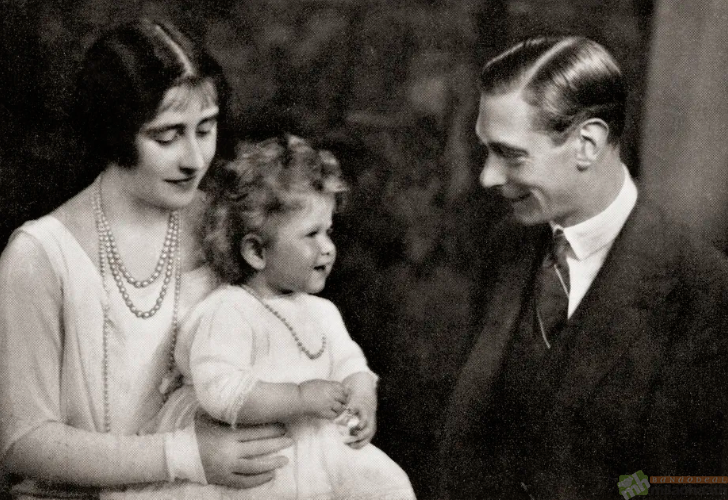
The Duke and Duchess of York with their daughter, Elizabeth, immediately after their return from Australia in 1927. Universal History Archive/Universal Images Group/Getty Images
Edward abdicated the throne in 1936, and Elizabeth’s father became King George VI. Elizabeth was now the heir to the kingdom and a valuable diplomatic asset. Hardman claims that the timid young princess found the transition challenging, but she applied her usual work ethic to her new existence. Alathea Fitzalan-Howard, a British peer, wrote in her journal about meeting “Lilibet,” Elizabeth’s childhood nickname, at a drinking party in 1941 and being proud of her. “Lilibet, like myself, finds talking difficult; but she did quite well,” she wrote. Elizabeth had already devised her favorite conversational strategy: “She insisted on bringing the dogs in,” Fitzalan-Howard added, “because she thought they were the greatest save to the discussion when it fell.”
Also Read |
Queen Elizabeth II: World Leaders Remember a ‘Kind-Hearted Queen’
Elizabeth’s father died in 1952, and the 25-year-old came to the throne. According to reports, she was first intimidated by the hard grind of life as a working queen. Hardman says that on a trip of Australia in 1954, “the Queen was heard to moan wearily (not unusually) that this endless diet of municipal platitudes was ‘boring, dull, boring.”
Nobody would ever find the queen saying something like that later in her reign. Instead, she was quick to chastise anybody who indicated that any of her royal tasks were dull.
According to Hardman, a former private secretary told the queen that a reception for the Commonwealth Auditors’ Association would be “very dull.”

Queen Elizabeth II and her husband Philip, Duke of Edinburgh, wave at the crowds from the balcony at Buckingham Palace after Elizabeth’s coronation on June 2, 1953. Keystone/Hulton Archive/Getty Images-Milao Haath
“‘She destroyed me,’ claimed the secretary. ‘ “This isn’t boring,” the Queen said. This is fascinating and significant because these are the folks who are raising standards and combating corruption in some challenging places. They require the encouragement and support that I and this business provide.” In other words, she recognises the significance of what she is doing in a broader perspective.”
That strict focus on the larger context, that insistence that her job is intriguing because it is vital, is part of the royal family’s sense of discipline provided by the queen. Such concentration is required in the monarchy since the task is never-ending. Being royalty is spending your life in public – not just for decades, but for your whole life.
“Celebrities flare and fade.” Brown argues in The Palace Papers, “The monarchy plays the long game.” “There is no time stamp on the public’s interest in you as long as it is evident that it is the public’s interest.” As Queen Mary, the Queen’s grandmother, reportedly told a relative, “You are a member of the British royal family.” We never get weary of going to hospitals.'”
Elizabeth’s reluctance arose as a natural result of this practice. Brown argues that she was “schooled” to “erect rigid, lifelong barricades around her inner thoughts and feelings.” Those restrictions would serve her well throughout her career. Brown adds that her unwillingness to conduct a single interview throughout her reign “only added to her mystery.”
Also Read |
Queen Elizabeth II has Died
“The Queen has the instincts of a performer.”
Elizabeth’s allure was genuine. Those who encountered the queen in the early days of her reign were stunned by her evident ability as a performer. Notably, she displayed stateliness rather than appeal.
Hardman quotes the Economist on the queen’s visit to France in 1971 when the UK was attempting to join the European Economic Community. “She remains a symbol across Europe in ways that Britons do not fully comprehend,” the Economist stated. What precisely is a sign of? “That extremely difficult combination of democracy and stability,” France’s foreign minister told the magazine.
Also Read |
Queen Elizabeth II: World Leaders Remember a ‘Kind-Hearted Queen’

Elizabeth talks with the Emir of Bahrain in 1979 in Bahrain. Tim Graham Photo Library/Getty Images-Milao Haath
President Barack Obama compared the queen to Nelson Mandela in 2016. He described them as “leaders who have seen so much, whose lives span such important epochs, that they see no need to posture or deal in what’s trendy at the time; individuals who communicate with depth and wisdom, not sound bites.” They are uninterested in surveys or fads.”
Danny Boyle, who directed the queen during her surprise appearance at the opening ceremony of the 2012 London Olympics, expressed it more simply. “The Queen has the instincts of a performer,” he wrote in The Palace Papers, “she is, after all, constantly ‘on stage.”
Elizabeth’s insistence on remaining on stage at all times allowed her to be all things to all people.
“She is meant to be as infallible as the Pope and as impartial as Switzerland, while simultaneously being human, fascinating, broadly optimistic, and always pleasant,” Hardman writes. The only one of those job criteria that the queen continuously failed at was being fascinated, which was a truly remarkable feat. Her biggest political vulnerability throughout her rule was a hazy perception that she was a little dull. In 2015, historian David Starkey observed, “She has done and spoken nothing that anyone will remember.”
Being unrememberable would be a win for a queen whose reign contained more than one royal scandal. Elizabeth, on the other hand, was more astute. The queen’s clean slate has allowed observers to creatively associate her with whatever side they chose throughout the last decade’s bustle of royal marriages, intrigue, and scandal.

Queen Elizabeth II, second from left, with the Queen Mother, Princess Diana, and Prince Charles in Scotland in September 1982. Tim Graham Photo Library/Getty Images-Milao Haath
The queen is a fervent defender of her grandson and his mixed-race bride in Lifetime’s small franchise of Prince Harry and Meghan Markle films. Meanwhile, the anti-Meghan group has plenty of opportunities to associate her with the palace machinery’s behind-the-scenes traditionalists known as “the Firm.” In The Crown and The Queen, screenwriter Peter Morgan imagines Elizabeth as uncomfortable, conflicted, and ultimately beloved as she faces each new controversy. Spencer imagines the queen as a twinkly-eyed enigma: the one member of the royal family Diana appears to look up to, yet maintained at a distance that adds to Diana’s isolation.
The queen’s loyalty to her second son, Prince Andrew, was the one remarkable exception to her capacity to ride out a controversy without comment. Andrew was charged with sex trafficking in 2011 with the legendary Jeffrey Epstein. According to Brown, the queen promptly sent for Andrew and asked him if the claims were genuine, and when Andrew refuted all charges, she “made it clear to the public that her second son had her entire protection.” She bestowed upon him the insignia of a Knight Grand Cross of the Royal Victorian Order, dubbed “her highest gong” by Brown.

The Duke of Edinburgh was at the Queen’s side for more than six decades of reign, becoming the longest-serving consort in British history in 2009- milao haath
Even after she supported Andrew failed, the queen refused to remove it entirely. In 2019, he gave a critically panned interview to the BBC regarding the allegations, during which he tried to explain his long-standing acquaintance with Epstein. He announced his retirement from royal life a few days later. He and the queen were seen riding together on the Windsor Castle estate two days later. Brown says that the queen hoped to bring him back into the fold once some time had passed.
After all, the queen had a long game to play. And, aside from Andrew, her enigmatic presence provided her the authority to undertake work far more important than surviving a few decades of scandals.
Also Read |
Queen Elizabeth II has Died
“That extraordinary ability she has to balance the mystique of the monarchy.”
As queen, Elizabeth played a unique role. Her immediate forefathers were all emperors or empresses. By the time Elizabeth ascended the throne, the concept of a British empress was out of the question: the British Empire was ended. Instead, Elizabeth would oversee the Empire’s transformation into the Commonwealth, an institution in which she would wield significant symbolic influence but little political power – not that she had much real political power elsewhere.

Elizabeth delivers the Queen’s Speech in the House of Lords during the opening of Parliament in May 2021. Chris Jackson/WPA/Getty Images-Milao Haath
Also Read |
Queen Elizabeth II: World Leaders Remember a ‘Kind-Hearted Queen’
Hardman adds, “It has been her job to yield authority and transmit sovereignty with a smile and a pleasant handshake.” “At the outset of her reign, she was still expected to hand-pick prime ministers, determine whether to dissolve Parliament and even oversee her country’s theatrical production while sailing around the world in a royal boat.” “Not any longer.” According to Brown, the queen was “a virtuoso throughout her reign at the art of courteous retreats while nevertheless retaining the illusion of power.”

Queen Elizabeth II_1926_to_2022_milao_haath
Because of her air of sovereignty, the queen was able to function as a significant political advantage even as her actual powers waned. According to Hardman, as the UK’s economic and military strength waned in the 1970s, the queen’s popularity kept the country “punching above its weight on the international stage.” He cites her 1976 state visit to France, following which then-President Valery Giscard d’Estaing changed his opinion of Britain as “weak” and himself as “not an anglophile” to describing the queen as “a perfect sovereign” and “rejoicing” at the prospect of a “new entente” between “the two oldest nations in Europe.”
Elizabeth was requested to serve as the ceremonial head of state of newly independent Papua New Guinea in 1975. “They loved her,” Hardman says, “because they needed someone impartial, and they appreciated the honours and medals she could bestow.”
Elizabeth’s clean slate was her superpower once more: it made her look so impartial that it would be safe to bestow vast ceremonial powers on her. It was as if she could only embody the entire power of the sovereign if she gave up the authority to say what should be done with it.
Also Read |
Queen Elizabeth II: World Leaders Remember a ‘Kind-Hearted Queen’
Antony Jay, an author of Elizabeth R, a 1992 biography that would have immense sway inside the confines of Buckingham Palace, saw the queen as having two distinct roles that were unique to her and her reign. “The Queen was head of state, a set and defined duty that applied to every monarch,” Hardman argues. The second function, which Jay referred to as “head of the nation,” was more personal and less precise, including her duty as a “center of allegiance,” an advocate of continuity, diligent public service, and much more.”

Elizabeth inspects the First Battalion Grenadier Guards at Buckingham Palace in May 2010. Anthony Devlin/AFP/Getty Images-Milao Haath
The queen was the monarch because the laws of succession made her such. But she was the nation’s leader due to her unusual political abilities, purposeful blankness and steady dedication to duty, and longevity.
On the queen’s talents, Hardman quotes former Prime Minister Tony Blair. “The remarkable capacity she has to reconcile the mystique of the monarchy while evolving with the culture of the country through time is why she’s been so successful,” Blair added. “That is her distinct intelligence, and that is what she excels at. She is a near-genius in a small ‘p’ political sense — nothing to do with party politics.”
With all traces of superfluous personality removed, the queen was free to function as a symbol – of whatever her viewers desired, of course, but also, and most powerfully, of stability. She acted as a connection between the end of an empire and the emergence of a global liberal democracy throughout her seven decades on the throne.

Queen Elizabeth II in 2015. Sean Gallup/Getty Images-Milao Haath
“It matters to people because she embodies wartime sacrifice,” Obama is quoted as saying by Hardman. “She embodies decolonization acceptance.” She embodies Cold War triumph as well as the virtues of a successful partnership.”
Even Cuban leader Fidel Castro recognised Elizabeth’s political importance. Hardman tells an incident about the prime minister of an undisclosed Caribbean country contemplating leaving the British Commonwealth. Castro warned him that as long as Elizabeth did not meddle in the day-to-day operations of the island, it would be a negative idea. “You want to be a huge tourist island, and she’s great for demonstrating your stability,” he explained.
“Take Elizabeth II out of the frame at the splendor of state dinners for visiting presidents, solemn obsequies for fallen war heroes, and the glorious theatre of the opening of Parliament, when the mere sight of her scarlet velvet ermine robe makes even the most unruly of MPs sit up straight,” Brown writes in The Palace Papers. “In an age when everyone has an opinion, she has kept the discipline of never sharing hers.” Her legendary stoicism has come to represent the nation’s endurance.”
The queen has acted as a bridge between the past and the present for almost 70 years, vital and uncompromising as concrete. Whatever her successor brings to the throne must be something entirely new.
Also Read |
Queen Elizabeth II has Died
King Charles III, formerly known as The Prince of Wales, was born in 1948 and became heir apparent on the accession of Queen Elizabeth II in 1952.

King Charles III, formerly known as The Prince of Wales, was born in 1948 and became heir apparent on the accession of Queen Elizabeth II in 1952.-Milao Haath
“Queen Elizabeth’s was a life well lived; a promise with destiny kept and she is mourned most deeply in her passing. That promise of lifelong service I renew to you all today. “
Please send your message of condolence using this form
A selection of messages will be passed onto members of the Royal Family, and may be held in the Royal Archives for posterity.
انا اللہ وانا الیہ راجعون