

Mountain Bluebird
Mountain Bluebird
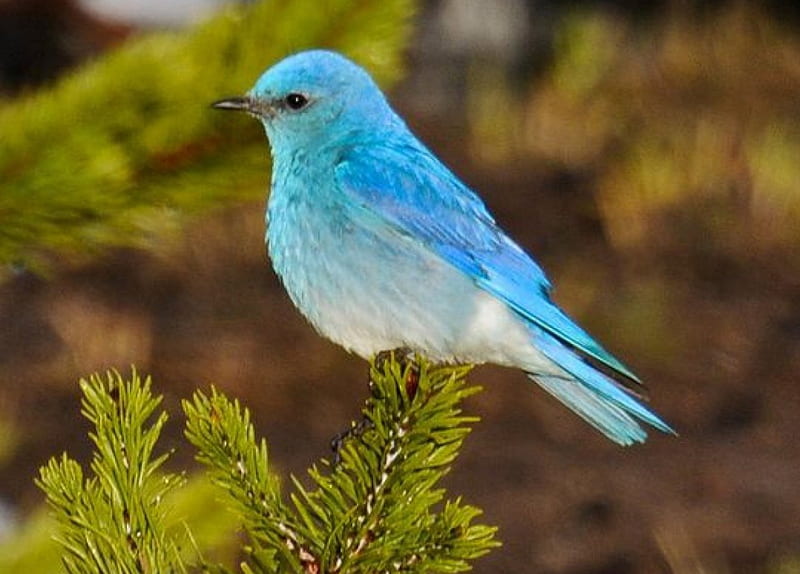
Mountain Bluebird is a medium-sized bird weighing around 30 grams with a length from 16-20 cm. They have light undersides and bruised eyes. Grown-up guys have dainty bills and are dazzling turquoise-blue and to some degree lighter under. Grown-up females have more blunt blue wings and tail, dim bosom, dark crown, throat and back.
Mountain Bluebird – Male
Table of Contents
Mountain Bluebird
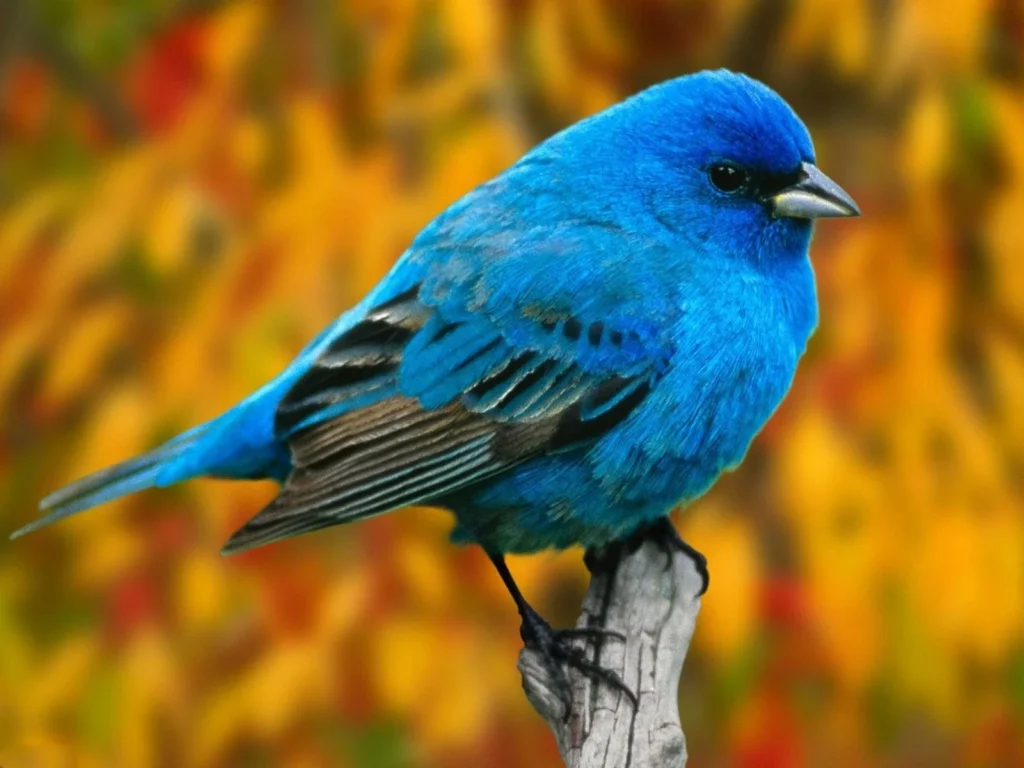
“A huge bluebird with no particular patches of orange or red on one or the other sex. Grown-ups are physically dimorphic in plumage tone yet not noticeably divergent in size. The upperparts of grown-up guys are a rich cerulean-blue, albeit the it are shadowy to wing tips. The throat and upper chest are an unmistakable cerulean-blue blurring to a light blue dropping down the bosom to the white lower midsection.”
Mountain Bluebird – Female
“Grown-up females are grayish brown on the head and upper back, at times touched a light cerulean-blue. The back end stands apart as a fix of light blue. The shade of the throat, chest and upper stomach are pale grayish brown, with the jaw region lighter than the throat and chest. The lower stomach and undertail coverts are white. The scapulars, essential, and tail feathers are a light cerulean-blue.”

Mountain Bluebird Habitat & Behaviour
The Mountain Bluebird’s favored environment is inadequately wooded fields or open forests. They require depressions for settling.
During winter, Mountain Bluebirds travel in herds, frequently with Western Bluebirds and Sparrows, and feed on bugs and little organic product, like mistletoe, hackberry, and currants.
They commonly start to move north in March, however frequently show up in northern scopes when snow actually covers a significant part of the ground temperatures actually plunge beneath – 20°C. These solid birds can for the most part endure short spells of cold and blustery climate; notwithstanding, during delayed extreme circumstances they might freeze or starve to death. Mountain Bluebirds now and again relocate alone yet more frequently travel in groups of up to 50 birds (seldom up to 200). They travel during the day at a relaxed speed, halting as often as possible to take care of.
They can some of the time be seen hung like splendid blue gems along a spiked metal perimeter, checking uncovered patches of ground for weed seeds and dead bugs. Exceptionally forceful birds, they generally sit essentially a meter separated. There is a constant glimmering of blue, as initial one and afterward another leaves its roost quickly to get a delectable piece.
Mountain Bluebird Diet & Feeding
Like different thrushes, Mountain Bluebirds are ground-feeders and eat generally bugs, insects, grasshoppers, and flies.
Where raised roosts are not promptly accessible, especially close to settle locales, the Mountain Bluebird will get a large portion of its food by drifting in the air a meter or more over the ground in a falcon like way, as it look through the earth beneath for food. Different individuals from the thrush family don’t utilize this drifting procedure.
Mountain Bluebird Nesting & Breeding
Before the last part of the relocation has gone through, occupant Mountain Bluebirds have spread out over regions with appropriate settling living space. Meagerly wooded fields, lush gorges and valleys, barren wasteland, and mountains generally meet the settling necessities of Mountain Bluebirds, however they will quite often keep away from treeless fields.
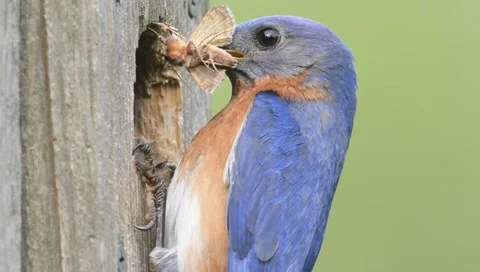
The guys frequently show up first, and burn through brief period in looking out reasonable settling locales: woodpecker unearthings and rotted holes in trees are utilized where accessible. In developed regions, they move into hardware, little hiding spots in structures, fence-posts, and utility shafts. As of late, the aviary has turned into a significant settling site.
When a male has a laid out area right off the bat in the season he will attempt to draw in a going mate through lovely singing. Guys might take part in flight shows, wing-wave shows, entering/leaving pit over and over. He might offer pieces of settling material and food. He may likewise dress his possible mate with an end goal to acquire her warmth. His overflowing presentation might keep going, now and again, for a really long time or even days,
Females appear to a be most inspired by the area – assessing the home box and encompassing region to guarantee it lives up to her assumptions. Her acknowledgment of the home site is generally a definite wagered assuming she enters the home site with settling material.
After a home site is settled upon, the two birds guard the prompt region. They assemble the home of dry grass stems and better plant material, while persistently watching and monitoring the new site against interlopers. This interaction might take somewhere in the range of two days to over seven days.
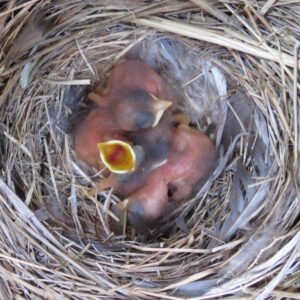
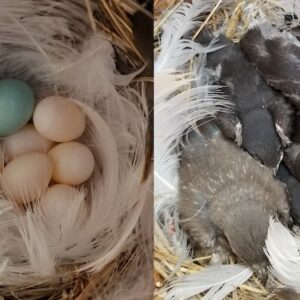
Not long after finishing the home, the female lays one egg every day until the grasp, normally with four to six eggs, is finished. Sometimes there ultimately depend on eight eggs in a grasp.
The two guardians will take care of the recently fledged youthful. Guys may takeover this obligation if the female beginnings another grasp. It has been recorded that youthful from the principal brood might assist with taking care of kin from the subsequent brood. There have been situations where three broods are kept in a season in eastern Alberta.
Banding research proposes that Mountain Bluebirds don’t hold a similar mate for more than one season.


Mountain Bluebird Life Cycle
⦁ Nest building – 1 to 6 days
⦁ Egg laying – 5 to 7 days
⦁ Incubation – 12 to 15 days
⦁ Nestling – 17 to 22 days
⦁ Fledgling – 21 to 28 days
⦁ Expected life span – 4 to 6 years,
oldest on record is 10 years, 5 months

Conservation History of Mountain bluebird
Bluebirds presumably were rarely normal, as they were restricted by their settling prerequisites. In any case, during the 1800s as pioneers spread out across North America and cleared vigorously lush regions, bluebird natural surroundings expanded. The pilgrims likewise controlled grassland fires, which permitted more trees to develop and create settling holes.
In the mid 1900s, the bluebird’s future looked encouraging. Yet, this time of favorable luck was fleeting: more pilgrims showed up, land turned out to be more significant, and a huge number of hectares of bluebird living space were totally stripped of trees every year for cultivating. Likewise, Europeans carried with them gatecrashers starlings and House Sparrows-which had little trouble in removing the bluebirds from the couple of outstanding home locales.
Bluebird numbers kept on declining until certain naturalists felt the bluebird was ill-fated to annihilation. Luckily, bird darlings across North America started during the 1920s to construct bluebird home boxes trying to turn around the decay. This preservation exertion truly became well known during the 1950s and 1960s. The outcomes have been empowering.
Today, people actually seek territory with bluebirds. Ranger service rehearses that eliminate dead trees and obstacles diminish the accessible settling depressions for bluebirds. Certain individuals have assisted with balancing this misfortune by making trails of bluebird home boxes. Tragically, some of the time others vandalize home boxes and obliterate their items.
Despite the fact that bluebirds will more often than not show up before the expected time enough in spring to get best option of the accessible home boxes, they should once in a while go after them with Tree Swallows, House Wrens, Chickadees, House Sparrows, and European Starlings. Starlings can be barred from the opposition by an entry opening no bigger than 3.8 cm (1 9/16″) in measurement. Also, every one of the three bluebird species contends with the others for boxes, where reaches cross-over.
Once introduced, bluebirds are well ready to protect boxes that are appropriately planned and set as they would prefer. Notwithstanding, where House Sparrows are plentiful they might enter a bluebird box and venture to such an extreme as to kill youthful and grown-up bluebirds. In spite of the fact that it is too enormous to even consider entering their home boxes, the really avian hunter of the bluebird is the American Kestrel, a little bird of prey. Homegrown felines and raccoons are considerable hunters of youthful and brooding female bluebirds. Deer mice and chipmunks can likewise be issues. Smooth metal posts will frequently keep creatures from ascending to settle boxes.
A parasitic blowfly Apaulina Stalia causes significant damage of bluebirds in certain areas, despite the fact that it isn’t remembered to lessen populace size. The fly lays its eggs in the bird’s home, and the hatchlings join themselves to the youthful birds and may kill them by sucking their blood. This parasite can be constrained by cleaning home boxes with diatomaceous earth.
Because of bluebird banding programs, we currently realize that a few bluebirds home when they are one year old. The typical age for a Mountain Bluebird is four to six years (most established is 10 years 5 months), and an Eastern Bluebird is roughly eight years. Banding has likewise shown that effective reproducers frequently return to a similar region or home site every year.
As opposed to mainstream thinking, not very many youthful bluebirds return to settle nearby in which they were raised. In one review region, short of what one percent of the youthful fledged were found settling around there in resulting years. Most likely, many don’t make due to raise, and survivors scatter to new regions. The erection of thousands of bird enclosures by concerned people and associations has been answerable for forestalling further consumption of bluebird numbers and in numerous areas has expanded populaces.
The area of a bluebird home box is significant. Home boxes ought to be set in semi-open regions like fields, fields, and rustic side of the road. A fence post in a clearing with dissipated trees around 20 m away is most likely a decent area. Home boxes in metropolitan regions or close to cultivate structures are normally involved by house sparrows.
The home box ought to be put on a post 1 m or more over the ground. The entry opening ought to be inverse to the overarching winds. Along these lines, on the off chance that your breeze is for the most part from the southwest, the entry ought to be set toward the upper east.
A “Bluebird Trail” comprises of a few home boxes dispersed 200 m or all the more separated and in a way helpful for review by walking or via vehicle, to record settling achievement, band youthful birds, and wipe out confines the fall. Normal investigations likewise permit the home overseer to eliminate homes of House Sparrows and different gatecrashers. A few paths might be just a kilometer long, while the longest runs a few hundred kilometers from Winnipeg, Manitoba, to North Battleford, Saskatchewan, with many kilometers of branch lines beginning from the fundamental path.
